Foundation Services in Houston, TX
Quality Foundation Repair Solutions in The Woodlands, Atascocita, Katy & Conroe
When your building’s foundation is in trouble, Level Check Foundation Repair is who to call to protect your investment. For more than 40 years, we have been helping homes and businesses around Houston, The Woodlands, and the surrounding areas with their foundation repair needs. Our insured and bonded experts will perform a detailed inspection to assess the extent of damage and develop the best strategy for your unique situation.
Our foundation repair services include:
- Concrete pressed piling
- Steel push pier
- Tunneling, excavation, and trenching
- Concrete services
- Pier and beam leveling
- And more!
For reliable foundation repair services in Houston, The Woodlands, and the surrounding areas, call Level Check Foundation Repair today at (281) 843-4314 or message us online!

Types of Foundation Projects We Handle
-
Houses
-
Garages
-
Apartments
-
Townhomes
-
Condos
-
Commercial Buildings
-
Driveways
-
Sidewalks
-
Pool decks
-
Warehouses
When Is Foundation Repair Necessary?
Your foundation supports your home or business by distributing its weight evenly and resisting settlement. When soil shifts, expands, contracts, or drains poorly, that support can fail, leading to structural damage that shows up as wall or brick cracks, uneven floors, sticking doors and windows, or a chimney pulling away from the building.
Properties in the Houston area face added challenges because of the region’s clay-rich soils and recurring wet and dry cycles. Houston’s expansive Beaumont Clay shrinks during drought and swells when wet, and this constant heave-and-settlement cycle is a primary driver of foundation movement. Level Check Foundation Repair tailors every assessment and solution to Greater Houston’s climate and soil conditions.
Warning Signs Your Foundation May Need Repair
Most homeowners don’t think about their foundation until something goes wrong. Knowing the warning signs early can help you avoid a much costlier repair down the road. Here are seven indicators worth watching for:
- Water pools around the foundation when it rains
- Cracks appear in the foundation itself
- Diagonal cracks run along interior walls
- Doors stick or become harder to open and close
- Cracks appear in exterior walls
- Gaps open between exterior walls and trim
- The kitchen countertop separates from the backsplash
Additional symptoms include drywall or ceiling cracks, sloping floors, siding separation, cracks through tile, brick and mortar deterioration, and a fireplace pulling away from the structure. Foundation problems can threaten the safety of your property and reduce its value. When your structure shows these signs, you can trust Level Check Foundation Repair to provide a repair plan that respects your budget.
Why Schedule a Foundation Inspection?
Foundation problems often go unnoticed until they cause significant structural damage. Routine foundation inspections catch issues early, before they become expensive repairs. A professional inspection from Level Check Foundation Repair can uncover underlying problems, including:
- Soil movement
- Settling
- Moisture damage
When we identify concerns, we give you a clear report and specific repair recommendations. Leaving problems unaddressed typically leads to uneven floors, sticking doors, and eventually structural failure.
A thorough inspection covers more than visible damage. We also analyze site conditions around the property that can affect long-term performance. In Houston, local building codes and permit requirements sometimes dictate approved repair methods, particularly in neighborhoods with notoriously shifting soils. Our team stays current with those requirements and incorporates them into every inspection, so the advice you receive is both effective and fully compliant.
Foundation Repair Methods Used in Houston
Choosing the right repair method matters as much as the repair itself. As a foundation contractor serving Houston since 1986, we match every approach to local building types and soil conditions, starting with a thorough assessment of the foundation and the soil beneath it.
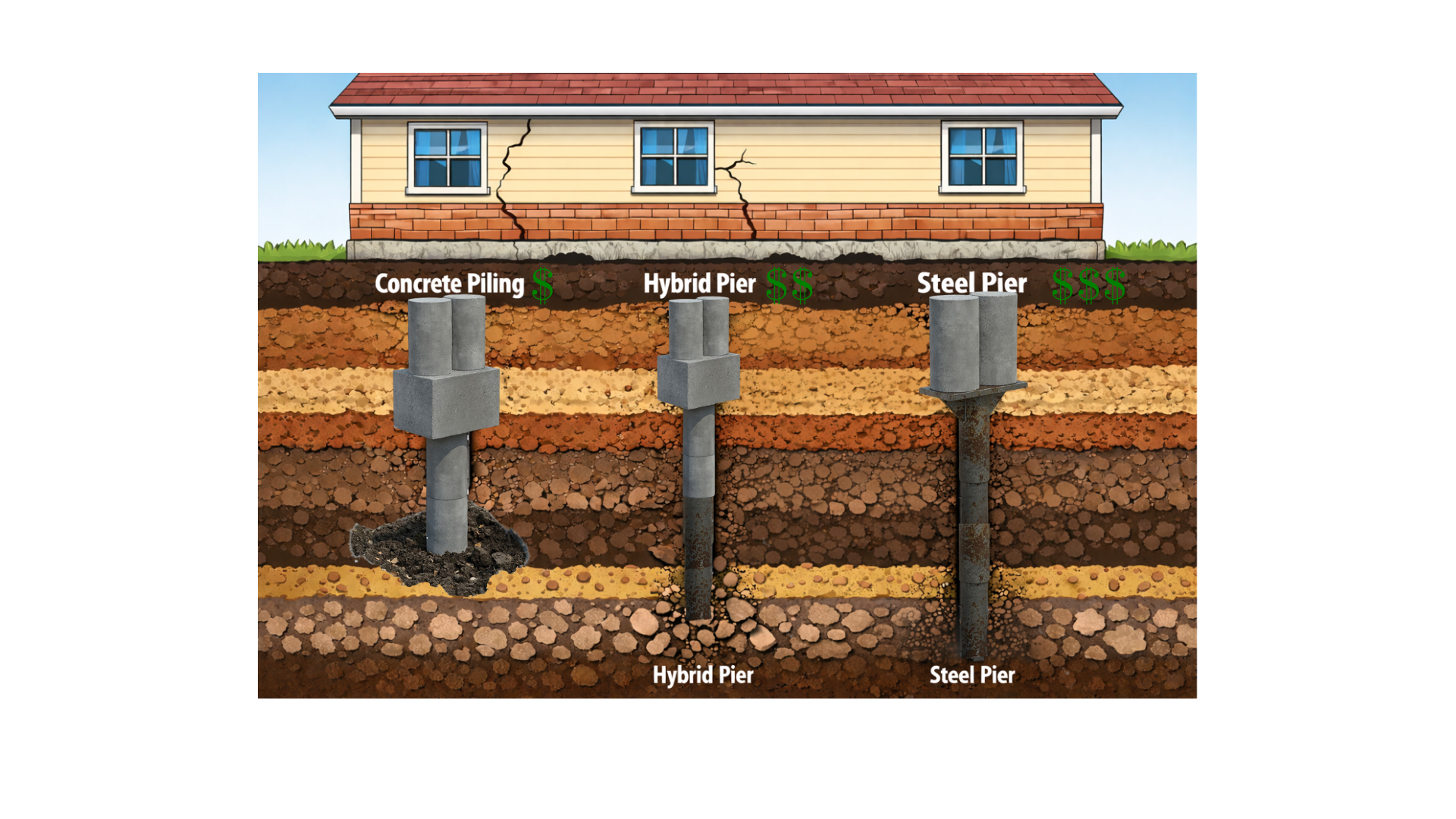
- Concrete pressed pilings are hydraulically pressed into the soil using the structure’s own weight as resistance. They work well for slab foundations on expansive clay, require minimal excavation, and offer a cost-effective solution for many Houston homes.
- Steel push piers are driven to load-bearing strata below the expansive Beaumont Clay layer, offering strong support and long-term stability for properties with significant settlement.
- Hybrid piers combine steel for the first five feet with concrete piling for deeper penetration, balancing performance and cost when expansive clay conditions are present.
Houston’s housing stock includes pier and beam homes in older neighborhoods alongside concrete slab foundations throughout newer subdivisions. Our in-house crews are experienced with both. Because we manage the full process as your foundation contractor in Houston, you get consistent, accountable service at every step.
Foundation Pier Systems: Applications, Pros & Cons
This guide explains the primary pier systems used in foundation repair, their advantages, limitations, and the scenarios where each method is most effective.
-
1. Concrete Pressed Piling Piers
Concrete pressed piling piers are concrete cylinders hydraulically pressed into the soil using the weight of the structure as resistance. These piers rely on soil compression and friction to support and stabilize foundations.
Pros:
- Lower cost, minimal excavation, simple installation.
Cons:
- Limited depth, less effective in expansive clay, potential for future movement.
-
2. Hybrid Piers (Steel + Concrete)
Hybrid piers utilize steel piers for the first five feet to improve strength and alignment, then transition to concrete piling for deeper soil penetration.
Pros:
- Deeper than concrete alone, balanced cost and performance.
Cons:
- More expensive than concrete, may not reach deepest strata.
-
3. Steel Piers (2 7/8-inch)
Steel piers are driven to load-bearing strata using high-strength steel pipe, providing maximum support and long-term stability.
Pros:
- Deep support, highest load capacity, best for expansive clay.
Cons:
- Higher cost, more complex installation.
Which Pier Is Right for You?
| Question | If YES? → | If NO → |
| Is movement minor & budget limited? | Concrete Piers | Next Question |
| Is expansive clay present? | Hybrid Piers | Next Question |
| Is long-term stability the priority? | Steel Piers | Hybrid or Concrete |
At Level Check, we can walk you through every viable option so you can choose the solution that fits your home, soil conditions, and long-term goals.
Our warranty is nothing to crack up about. We can help. We offer a Lifetime Transferable Warranty covering 100% of the work. When you sell, the new owner gets the same protection.
Don’t wait to protect your home. With our competitive pricing and flexible financing options, you can get the repairs you need without sacrificing your home’s integrity.